Carbazole Dioxazine Bluer Tone Specialty Pigment

Pigment Violet 23

Carbazole Dioxazine — Bluer Tone

A high-intensity, cool blue-violet carbazole dioxazine pigment with extraordinary tinting strength and transparency. The global industry standard for deep violet shades, optical brightening, and yellow-tone neutralisation in coatings, inks, and plastics.
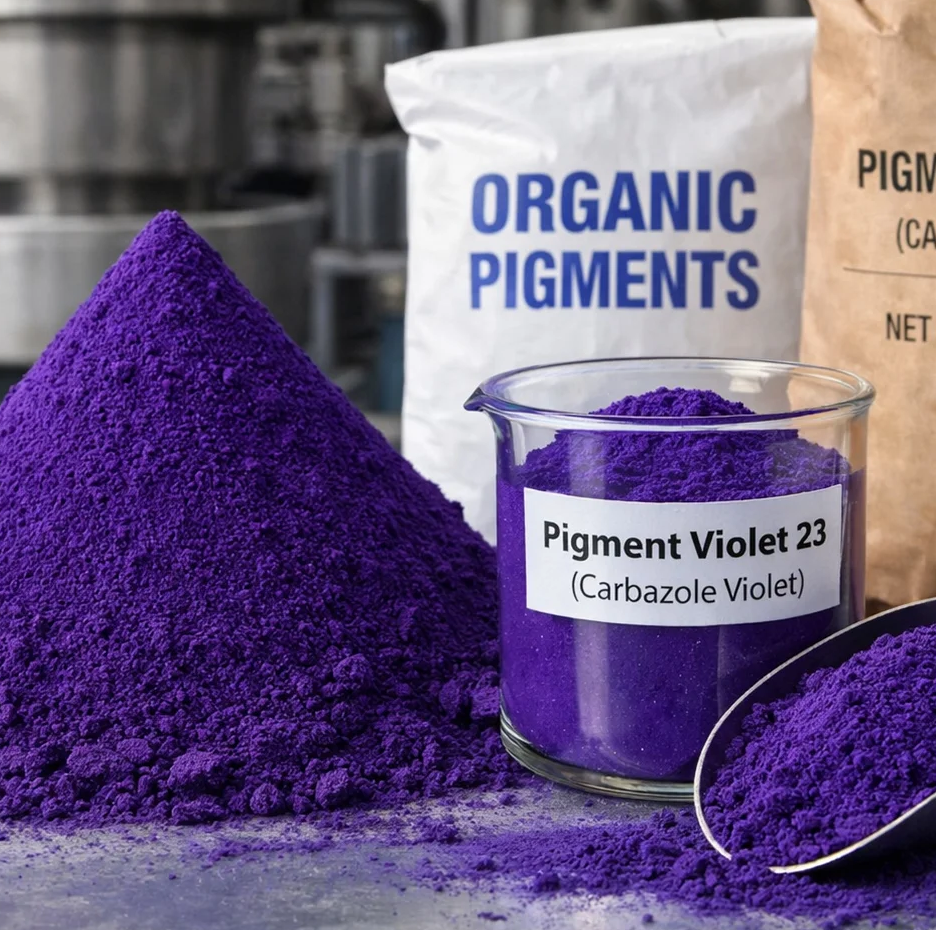
pigment photo
CI Name
Pigment Violet 23
CI Number
51319
Shade
Deep Blue-Violet
Forms
Powder · Hi-Conc. Paste
Heat Stability
Up to 200 °C
Product overview

Specifications

Industry-standard toning pigment

Pigment Violet 23 is one of the most widely used violet pigments globally, prized for its extreme tinting strength — often used at 0.01–0.1% loading to neutralise yellow undertones in white paints, optical brighteners, and process colour systems.

Chemical class
Carbazole Dioxazine (Dioxazine Violet)
Colour Index name
Pigment Violet 23
Colour Index number
CI 51319
CAS number
6358-30-1
Molecular formula
C₃₄H₂₂Cl₂N₄O₂
Molecular weight
589.47 g/mol
Shade tone
Deep blue-violet (cool masstone)
Variant
Bluer tone (see also: Redder tone variant)
Transparency
Transparent to semi-transparent
pH (10% slurry)
6.5 – 8.0
Available forms
Powder · High-Concentration Paste
Heat stability
Stable up to 200 °C
Technical performance

Performance Properties

PropertyStandard / NoteRating
LightfastnessISO 105-B02
Excellent (5/5)
Tinting strengthExtreme — use at low %
Excellent (5/5)
Heat stabilityUp to 200 °C
Very good (4/5)
Transparency
Excellent (5/5)
Acid resistance
Excellent (5/5)
Alkali resistance
Excellent (5/5)
Solvent resistanceDIN 55983
Very good (4/5)
Migration resistance
Very good (4/5)

Understanding Toning Power

PV23's extreme tinting strength means a small amount goes a very long way. It is most often used at trace loadings for tone correction rather than as a primary colour.

For white paint toning
0.005% – 0.05% loading neutralises yellow cast
For full violet shades
5% – 15% loading depending on system and opacity
End-use markets

Applications

Colour Correction & Toning

The primary global use for PV23. Used at trace levels in white architectural and industrial paints to neutralise yellow undertones and achieve a clean, neutral white finish.

Printing Inks

Offset, gravure, and flexographic inks. Exceptional transparency and tinting strength make PV23 ideal for violet and purple process shades and for tinting cyan–magenta combinations.

Plastics & Masterbatch

Used in injection-moulded and extruded plastics for deep violet shades and for fluorescent whitening effects by toning transparent or natural-colour compounds.

Coatings

Architectural, automotive, and industrial coatings requiring violet shades or subtle toning. Outstanding lightfastness ensures long-term colour stability in exterior applications.

Product forms

Available Forms

Dry Powder
Hi-Conc. Paste
Custom Blend

High-concentration paste forms are recommended for accurate low-level dosing in toning applications. Custom particle-size grinds, surface treatments, and flush pastes available on request.

Compliance

Regulatory Status

REACH Registered

Registered under EU REACH regulation. Full SDS available on request for compliance and procurement documentation.

Heavy Metal Free

Contains no lead, cadmium, mercury, or chromium VI. Meets international packaging and environmental directives.

Tone variants

Bluer Tone vs. Redder Tone

PV23 — Bluer Tone

Cool, blue-leaning masstone. Preferred for optical whitening, cyan-bias violet shades, and process colour work where a clean, cool hue is required.

Masstone biasBlue-violet (cool)
Best forToning whites, process inks
TransparencyHigh

PV23 — Redder Tone

Warm, red-leaning masstone. Preferred for deep purple-red shades in paints and inks, and for violet shades with a warmer, more saturated appearance.

Masstone biasRed-violet (warm)
Best forDeep violet-red shades
TransparencyMedium-high
View Redder Tone →